Best Eyebrow Shape for Your Face Shape
The short answer
The best brow shape balances your face toward an oval: high arches for round faces.
Why Face Shape Matters for Brow Design
The eyebrow is the primary framing element of the upper face. Its height, arc, thickness, and tail length all alter the perceived proportions of the face beneath it. Aesthetic medicine and makeup artistry converge on the same observation: a well-matched brow makes the face appear more balanced, while a mismatched brow can visually widen a face that reads round, or elongate one that already reads long.
The underlying principle, confirmed in published aesthetic research across multiple studies, is that the oval face is the reference ideal — a face roughly 1.5 times longer than it is wide, with balanced forehead and cheekbone width tapering gently to the jaw. For people with oval faces, brow selection is primarily a matter of preference. For every other face shape, the brow can be engineered to nudge the visual impression toward that oval.
How to Identify Your Face Shape
Before applying any brow recommendation, you need to identify your face shape accurately. Pull your hair away from your face completely and look straight into a mirror in neutral lighting:
- Forehead width: Is your forehead wider than your jaw, narrower, or roughly equal?
- Cheekbone width: Are your cheekbones the widest point of your face?
- Jaw shape: Is your jawline rounded, squared, or pointed?
- Face length: Is your face noticeably longer than it is wide, about equal, or wider-looking?
The common face shapes and their defining characteristics:
| Face Shape | Forehead | Cheekbones | Jaw | Length |
|---|---|---|---|---|
| Oval | Slightly wider than jaw | Moderate | Gently rounded | ~1.5× as long as wide |
| Round | Similar width to jaw | Widest point | Rounded, soft | Nearly as wide as long |
| Square | Similar width to jaw | Similar to forehead | Angular, strong | Length ≈ width |
| Heart | Widest part of face | Moderate | Narrow, often pointed | Variable |
| Diamond | Narrow | Widest part of face | Narrow | Variable |
| Long / Oblong | Similar width to jaw | Similar widths throughout | Slightly rounded | Noticeably longer than wide |
Oval Face: The Versatile Canvas
Defining feature: Gentle taper from slightly-wider forehead to softer jaw; face roughly 1.5× longer than wide.
Best brow: A soft, naturally arched brow that follows the natural growth pattern. Most arch heights, thicknesses, and styles work on an oval face.
What to avoid: Extremes — a very flat brow or an extremely high, sharp arch both introduce an element that was not there. The goal is to maintain the existing balance.
Practical guidance: If you have an oval face, your primary brow decisions are about personal preference and brow density rather than corrective shaping. Maintain the natural arch and focus on grooming — threading or waxing strays, filling sparse areas evenly.
Round Face: Add Vertical Lift
Defining feature: Soft edges, rounded chin, cheekbones are the widest point, face is nearly as wide as long. The challenge: the horizontal emphasis of width needs a counterbalancing vertical element.
Best brow: A higher, more defined arch with the peak placed slightly toward the tail of the brow. The arch creates a vertical line that draws the eye upward and makes the face read longer than it is wide.
What to avoid:
- Rounded brows on a round face reinforce the circularity — a rounded brow on a rounded face looks rounder, not more balanced
- Very flat brows remove the only vertical element you have to work with
- Very short tail length reduces the horizontal span of the brow and makes the face look wider
Practical guidance: When mapping your arch point (middle of iris to nostril), consider placing it very slightly past the iris, toward the pupil edge. This shifts the peak laterally and adds the visual lift a round face needs. Keep the tail at full length — ending where the nostril-to-outer-eye diagonal points.
Square Face: Soften the Angles
Defining feature: Strong, angular jawline; forehead and cheekbones of approximately equal width; face is roughly as long as it is wide, with defined corners.
Best brow: A soft, curved arch without sharp angles. The curve introduces a contrasting line that visually counteracts the hard geometry of the jawline. A gentle arc from head to tail, with moderate arch height.
What to avoid:
- Very angular, sharply peaked arches echo the jaw's angularity and make the whole face read harder
- Thick, horizontal brows with no arch can visually widen an already-wide jawline
- Brows that are too thin — the square face needs enough brow presence to provide visual framing without becoming a feature that emphasizes angular contrast
Practical guidance: When filling the brow or threading, aim for a smooth, continuous curve from head to arch to tail rather than a distinct angle at the arch peak. Brow thickness of medium width tends to work well: present enough to frame, not so bold they overpower.
Heart Face: Balance the Wide Forehead
Defining feature: Wider forehead and upper cheekbones tapering to a narrow, often pointed chin. The widest part of the face is at the top.
Best brow: A low, gently rounded arch with medium thickness. The logic: the heart face already has strong emphasis at the top (the wide forehead), so adding a high arch compounds that top-heavy visual weight. A lower, softer arch distributes attention more evenly down the face.
What to avoid:
- High arches draw attention directly upward to the widest part of the face — the opposite of what is needed
- Very thin brows leave too much visual space on the forehead, amplifying its width
- Very short tails further reduce horizontal brow span and allow the forehead to dominate
Practical guidance: Resist the urge to over-arch. The brow should follow a natural curve without a pronounced peak. Keep brow thickness moderate to full — the brow's visual weight helps balance the wide forehead against the narrow chin below.
Long / Oblong Face: Add Visual Width
Defining feature: Face is noticeably longer than it is wide, with similar widths at forehead, cheekbones, and jaw. The challenge: counteract the long vertical dimension.
Best brow: A flat, nearly horizontal brow with minimal arch — the arch should be very subtle. Horizontal lines read as width; a flat brow visually shortens the face and creates the impression of more width.
What to avoid:
- High, pronounced arches exaggerate the vertical dimension and make a long face read even longer
- Short tails reduce horizontal brow length; on a long face, you want maximum horizontal span
- Very thin brows minimize the brow's horizontal contribution
Practical guidance: When mapping, place the arch point only very slightly higher than the natural growth line — enough to tidy the shape but not enough to create a pronounced peak. Let the brow run as horizontal as your natural growth allows.
Diamond Face: Soften the Cheekbones
Defining feature: Narrow forehead, very wide cheekbones, narrow jaw — the cheekbones are the dramatically dominant feature. The face can look angular and geometric.
Best brow: A rounded, softly curved brow that avoids adding any additional angular emphasis. The curve draws attention horizontally across the forehead (widening it visually) without creating an angular contrast that echoes the cheekbone prominence.
What to avoid:
- Very angular or sharply peaked arches — they echo and amplify the angular cheekbone
- Very sparse, thin brows — the diamond face has a naturally narrow forehead; too-thin brows leave the forehead looking bare and emphasize its narrowness
Practical guidance: A soft, continuous curve with moderate thickness works best. Consider keeping brow tails at full length to maximize horizontal reach at the face's upper third.
The Comparison at a Glance
| Face Shape | Arch Height | Arch Style | Tail Length | Thickness |
|---|---|---|---|---|
| Oval | Natural | Natural curve | Natural | Any |
| Round | High | Defined, peak slightly lateral | Full | Medium–full |
| Square | Medium | Soft, curved — no sharp angles | Full | Medium |
| Heart | Low | Gentle, rounded | Full | Medium–full |
| Long / Oblong | Low–flat | Minimal, nearly horizontal | Long | Medium |
| Diamond | Medium | Soft, rounded | Full | Medium |
Important Caveats: Rules Are Starting Points, Not Prescriptions
Published aesthetic research explicitly notes that no single arch placement method has been proven empirically superior to others. Face shape categories are themselves generalizations — real faces are more variable and nuanced than any six-category grid can capture. And crucially: your natural hair growth pattern matters enormously.
If your follicles grow in a direction that makes a specific shape very difficult to achieve without extreme thinning, the better choice is usually to work with your growth pattern and fill strategically, rather than over-pluck to force a shape.
Use these guidelines as a starting point for conversations with a professional brow technician. A skilled threader or brow artist will map your face, assess your natural growth, and give you a shape that is both flattering for your face geometry and achievable with your follicle density.
See eyebrow-shaping-guide for the full technical process — the three-point mapping technique, method-by-method comparison (threading vs. waxing vs. tweezing), and at-home maintenance steps.
Products that fit this guide
Picked by code from each product's full ingredient list.

Catrice
Brow Fix Shaping Wax
brow product · 1 g · 11 ingredients
- Fragrance-free
- No essential oils

Catrice
Drunk'n Diamonds Eyeshadow Stick
eyeshadow · 2.5 g · 17 ingredients
- Fragrance-free
- No essential oils
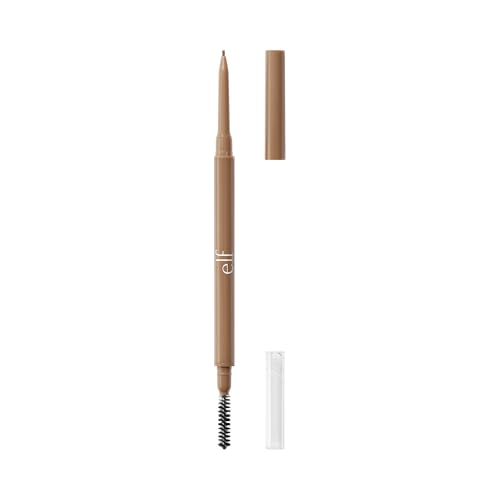
e.l.f.
Micro-Fine Brow Pencil
brow product · 0.03 g · 16 ingredients
- Fragrance-free
- No essential oils
- With vitamin E

Essence
All Eyes On Me Waterproof Mascara
mascara · 8 ml · 20 ingredients
- Fragrance-free
- No essential oils
- With glycerin
Frequently asked questions
Does the research support the idea that brow shape should match face shape?
Yes, with nuance. Studies published in peer-reviewed surgical and aesthetic journals — including a comprehensive empirical review across MEDLINE, Embase, Scopus, and CENTRAL databases covering studies from 1962–2022 — confirm that makeup artists and aesthetic physicians modify brow shape to compensate for non-oval face shapes, using the oval as the reference ideal. However, the same research acknowledges that many of these aesthetic criteria lack rigorous experimental validation. The face-shape brow matching system is well-supported as a professional framework, but individual variation means rigid adherence to any formula can produce brows that feel unnatural for a specific person.
How do I know if I have a round or an oval face?
Pull your hair fully back and look at your face in a mirror. An oval face is noticeably longer than it is wide — roughly a 1.5:1 length-to-width ratio — with a gentle taper from the slightly-wider forehead to the softer jaw. A round face is closer to equal in length and width, with the cheekbones as the widest point and a soft, rounded chin. A practical test: if your face looks about as wide as it is long, with soft edges throughout, it is round. If there is a clear length difference, it is likely oval or long.
Can I change my eyebrow shape to suit a different face shape?
Within the limits of your natural hair growth, yes. Threading, waxing, and filling techniques can adjust arch height, tail length, and apparent thickness to approximate a target shape. However, the range of change achievable depends on your natural brow density and follicle position. A very sparse brow cannot easily produce a full, defined arch shape without significant filling; a naturally high-arched brow cannot easily be made flat without heavy coverage makeup or professional removal. Work within your natural growth pattern where possible.
Do thick or thin brows suit certain face shapes better?
Thickness (brow height, not hair density) plays a role in balance. Generally, a fuller brow with some substance works well on square, heart, and round faces because it provides visual weight that frames the face. Very thin brows can look sparse on wider face shapes and tend to date the look (strong association with the over-plucked styles of the 1990s). On long faces, medium thickness works well. On oval faces, thickness is a personal preference. The key variable is not so much face shape as it is maintaining brow proportions that make sense for your facial bone structure.
Should my eyebrows be exactly symmetrical?
No — perfect bilateral symmetry is not a realistic or necessary goal. Human faces are naturally asymmetric; the two sides of the face have slightly different bone structures, skin textures, and follicle patterns. The practical goal is for both brows to use the same three-point mapping framework (same start, arch, and tail geometry relative to each side's facial landmarks) and look balanced together. Chasing mirror-perfect symmetry often results in progressive over-plucking as you keep evening up small differences.
Sources
- 01Aesthetic analysis of the ideal eyebrow shape and position — PubMed / European Archives of Oto-Rhino-Laryngology, 2014-10-28. Eyebrow aesthetics vary by race, age, and gender; the oval face is the reference for brow design; previous studies describe ideal brow shape primarily for oval-faced models, and makeup artists modify brow shape to create the illusion of an oval for non-oval face shapes.
- 02Techniques of Eyebrow Lifting: A Narrative Review — PubMed Central / Plastic and Reconstructive Surgery Global Open, 2020-03-01. Comprehensive assessment of eyebrow shape and position is essential; the shape of the aesthetic brow and its relationship to face shape has been described; arch position recommendations by face type are established in aesthetic practice.
- 03Eyebrow Shape Preference Across Age, Gender, and Self-Reported Attractiveness — PubMed, 2023-01-01. Eyebrow shape preference varies by age, gender, and individual factors; no single shape is universally rated most attractive.